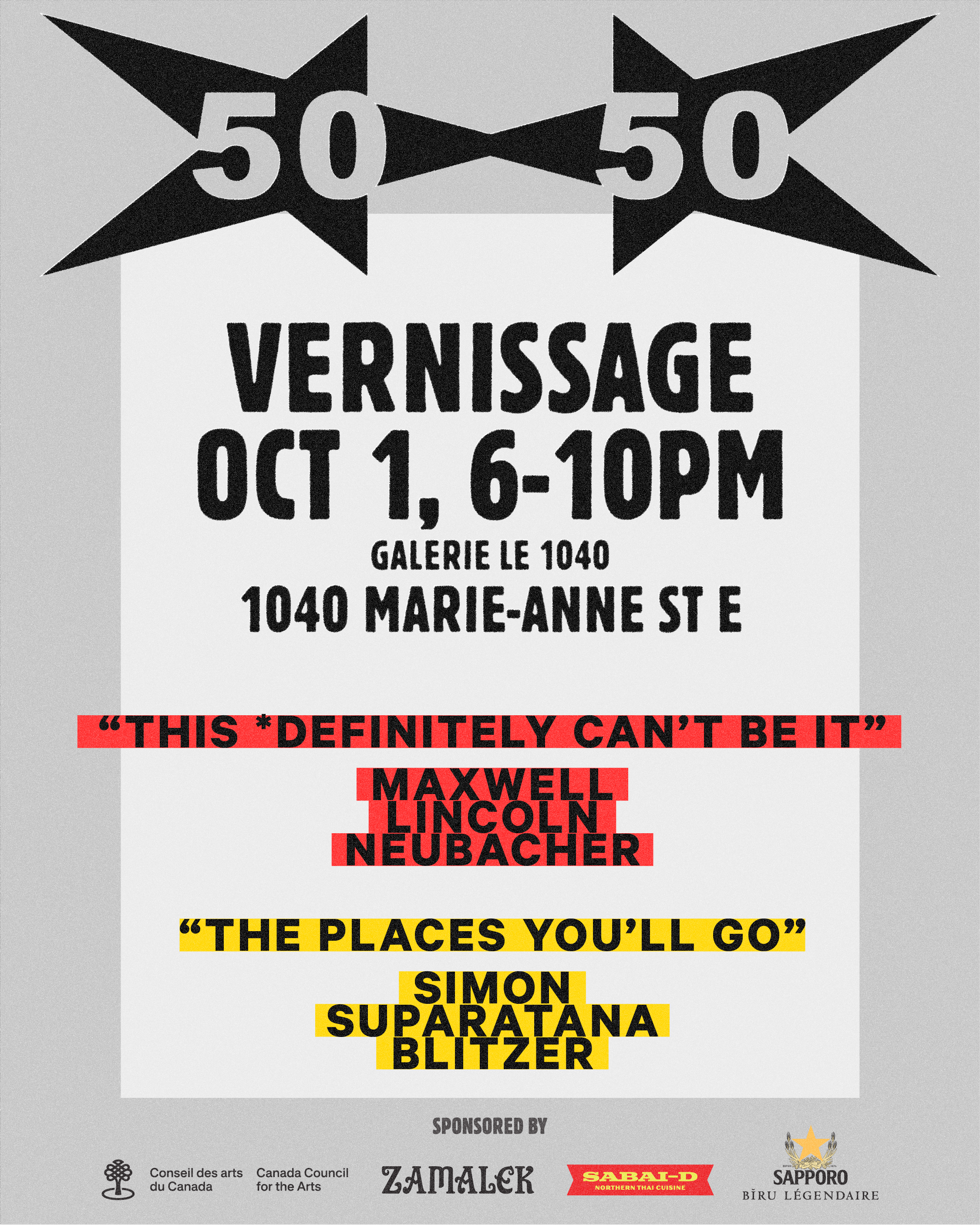
I sat down with artists Simon Suparatana Blitzer and Maxwell Lincoln Neubaher, alongside curator Maggie Rossy-Aulman, ahead of their upcoming expo 50/50. We grabbed a table at Café Club Social in the Mile End to chat about decade-long friendships, all the fun-chaos of planning a week’s worth of events, nostalgia, and what happens when you pair childlike wonder with a healthy dose of cynicism.
50/50 isn’t just a gallery show; it is also a full week of community programming, creating a space that feels warm, lived-in, and accessible. You won’t want to miss a singlen event.
Grab an espresso, or a beer, and dive into our conversation below to learn a little more about Simon’s collection (The Places You’ll Go) and Maxwell’s collection (This Definitely Can’t Be It). This expo explores how they have constructed identity, belonging, and memory through their moments of transition and uncertainty throughout their adolescence.
Kitty: Anyone want to go first?
Simon: Sure.
Kitty: Okay, Simon. First of all, I want to say I was obsessed with Dr. Seuss as a kid, and maybe painted my room Dr. Seuss-themed a bit too late in life. . .
The title, The Places You'll Go, makes me think of a journey in anticipation, but where does this story actually begin for you?
Simon: It would begin in Thailand for me. I was born in Canada, but I moved to Thailand when I was one, so my earliest memories are from there. I had an older brother who remembered Canada, and my parents remembered Canada, so that was where I was constructing this idea of what it was and what it looked like. The first books I was reading were Dr. Seuss.
Kitty: In English or in Thai?
Simon: In English. I think Green Eggs and Ham was the first book I read.
Kitty: Do you speak Thai?
Simon: I speak a bit of Thai, but I would say it's confined to a 6 or 7-year-old level, because that's what I was. Everything's around a Dr. Seuss level for me. That's where it started, and I like to think of it through the mind of a kid going to a new country. I was only getting information from my brother who was telling me all this crazy stuff, and my parents telling me certain things and teaching me how to read. So that's where it all started.
Kitty: From what I remember of Dr. Seuss's Oh, the Places You'll Go!, the message is that you're the driver of your own life—you make what you want happen. Do you think that taking these muted grayscale images and then adding color into them is your way of stepping into reality, bringing color to your own life, or making your life colorful?
Simon: I wouldn’t say so. I would say it's a way of taking this landscape and putting a bit of my identity into it. The general idea of the work is more of a child's perspective on immigration, where you're not really in control. You're kind of just going with wherever your parents are taking you or wherever the world is taking you. So, I don't think there's that much of a parallel in the sense of controlling where I'm going. I want the message to be more that no matter where you end up, you can kind of make it your own.
Kitty: I like the process of your work. Can you describe what it is a little bit?
Simon: Sure. I was inspired initially by actual painted photographs. That method's a bit hard for me to do digitally since I'm doing everything on a computer. So I took inspiration from Japanese woodblock printing, where they have a key block—which is the negative—where they carve in all the blacks to create the outlines. Then you do different layers of color on top of it, similar to linocut printing. I'm doing a digital version of that in Photoshop, masking out these different color zones and layering them up.
Kitty: Where do you think this process of recoloring comes from when you look back at your childhood and your move from Thailand to Alberta?
Simon: I think it grounds me to my childhood and memories of my childhood a whole lot. As an artist, I'm trying to connect more with my Thai roots, and this is one of the first steps to doing so. Although the photos were taken in Alberta, it's all inspired by things that happened in Thailand. I'm feeling a real big draw to my childhood and celebrating that.
Kitty: Have you been back to Thailand at all?
Simon: Last time was 2018, so yeah.
Kitty: Hey, Max. Max or Maxwell?
Maxwell: Lately it's been a lot more Maxwell, but whichever is fine. Everything in writing is Maxwell. Certain people call me Maxwell more now for some reason. Maybe it's getting older.
Kitty: Do you like it?
Maxwell: I think I'm silently manifesting it. I'm an adult, and it's a nice name. I used to push it away, but yeah.
Kitty: Looking at your work from ages 20 to 25 next to your work from 25 to 28, what stands out the most? Has what you've been drawn to take photos of shifted between the two chapters?
Maxwell: To be honest, I don't think it has changed very much. When I look at the photos, I see a lot of similarities in the scenarios I'm in, the people I'm around, the nightlife, and who I'm hanging out with. What has changed is that the photos from the first show covered five years—ages 20 to 25—whereas this second chapter is only three years, so there are significantly fewer photos. That plays into being busier with life, work, and responsibility, but also picking and choosing a bit more. I can't say the photos are better than the first part, but they are more intentional and specifically drawn to certain trips, events, or how I was feeling, you know? There are definitely stronger parallels, for sure.
Kitty: That’s funny you say that, because my next questions is…
It seems like with digital, it's so easy to take endless photos and move on. Does working with a limited roll of film force a different kind of attention or presence toward which photos you actually take?
Maxwell: For sure. What I think I really love is the balance. With digital, you can take endless amounts, but with film, I'm picking one moment and shooting it maybe 5 or 6 times if I'm bracketing or trying something out exposure-wise. It's fun to say, "No, this is the moment, and I'm going to try every little angle," without shooting hundreds of photos throughout the entire day or trip. It's tight, specific, and done with intention—each click has intention. It is limiting, but it helps me slow down and understand that this is what I want to shoot.
Kitty: Thinking about this dynamic of seeing your 20-to-25 and 25-to-28 periods blown up as photographs, do you find that's kind of like therapy or a visual journal looking back?
Maxwell: Oh yeah, I mean that's what this whole project is. This Can't Be It is going to be three parts, and the third part when I'm 30 will be titled This Is It. And as dark as it is, it's the chapter of my 20s. It's not a negative thing; its just more that’s it. It was originally going to be two parts—20 to 25, and 25 to 30—but this project with Simon, 50-50, was a good middle ground at age 28. These three chapters let me look back at everything, and think, “oh, this happened”, “where was I?”. When I am 40 or 50, I can look back at all these images and even the memories of this show, and think about photos from trips, or think “you’ve changed so much since then”. I think there is something nice about that. So, it’s a time stamp, for sure.
Kitty: As you said, this is a time for you to slowdown and reflect. What role does the physical medium of film versus digital play in processing all these different emotions you’ve been feeling. You have kind of answered that already, but can you expand?
Maxwell: Yeah, I mean, what I really loved is when I was going through all the images I've taken over these years,I noticed something interesting: in my digital camera roll on my phone, around a single film photo, there will be 60 digital photos from the day of or the night after. It's interesting to pick out the exact moment I chose to shoot on film, while all these other surrounding stories exist in digital. And I think that’s nice, that separation between the two.
Kitty: It kind of reminds me of my work as a teacher, we just banned phones from school, and we got a bunch of digital cameras so they can process and capture moments differently. Like you were saying. Anyways…
This one maybe you both can answer, since your friendship spans 10 years, in what ways is sharing the gallery and putting your work side-by-side on the walls just as much a celebration of this time as the photos themselves?
Maxwell: I feel like Simon and I have only gotten closer over the years. That’s obviously every friendship. That’s just how they work. We've had a consistent friendship because we've both lived here and stayed in each other's lives. Doing this together felt very natural. When Simon approached me to do this together, it made sense and fell right in the middle of the two This Can't Be It shows. It felt very organic.
Simon: I think we've been in each other's orbit creatively for a really long time. It’s about time we did something.
Kitty: I like the contrast in your titles. Simon, yours feels like a wide-eyed promise of a great ride ahead, whereas Max, yours feels dry, weary, and sarcastic. What do you feel about my reading of that?
Maxwell: Oh, I think you’re spot on.
Simon: There are a lot of opposites going on between our personal themes.
Maxwell: I’m looking at it still through a sarcastic or slightly dark lens—it's the idea that it's not all pretty forever. Growing up means realizing these realities. My work speaks to that; we’re dancing on the line between good and bad. As pretty as Simon's work is, it represents the first chapter in a long life, followed by the sarcasm and letdowns of growing up.
Simon: We're looking at different slices of growing up. My work represents innocent, childlike wonder, which then moves into young adulthood where you grow up and maybe start to get a bit more cynical.
Kitty: Maggie, since you're usually the one behind the camera, how does your own eye as a photographer shape the way you curate and arrange their work?
Maggie: What I’ve been thinking a lot about in my role as producer and curator is that I'm Max and Simon's first audience, which is an important role. As an artist, showing your work to the world for the first time is a very vulnerable place to be, so they put a lot of trust in me. I feel honoured by that role. I know how to be honest with both of them, and they value my feedback because I understand that vulnerability from my own experience exhibiting art and photos. I’ve felt that vulnerability, and I know it's great to have someone you trust to give feedback before taking the next step of showing it to everyone else.
Kitty: Since the expo focuses mostly on young people’s identity through memory, imagination, storytelling, and immigration, what drew you to this specific theme, or where did the name 50-50 come from?
Maggie: The name was their idea. They came to me with this name and wanted to do a show together, and I guided a little bit in the narrative and writing to find where the crossover and connections were.
Maxwell: Maggie really built the show in the sense that she looked through our work and saw where we could connect this. When Simon approached me, the initial idea for 50/50 was to rent a space with two rooms or put a line down the middle so the shows were separate. But as we looked at the work, we realized it became one. We are dancing on similar ideas. 50/50 touches on dualism—good and bad, happy and sad. It's about splitting everything equally so it's a shared show rather than two individual shows.
Kitty: What's the most exciting part about turning two very different styles into one cohesive conversation?
Simon: You learn a lot about your own work when you bring two different themes together and find the similarities. I've learned a lot more about my work, I've learned a lot more about Max's work, and it just makes you appreciate both a little bit more.
Maxwell: It's fun to look at Simon's work and think about my own stuff as something bigger and more serious. I take inspiration from Simon, and think “you know, maybe I could print this bigger. Maybe this would look better at this scale, this colour, etc.” I realize I don't have to limit myself to thinking these photos are just from a night out—they have intention. Even if the scales are different, with Simon printing massive and me printing smaller, they carry equal weight.
Maggie: Even though there are two artists, it's two sides of the same coin rather than a divide. Curating a solo show versus a two-artist show versus a group show creates dynamics, conversations, and themes that are unique compared to a solo or group exhibition.
Kitty: Beyond the expo, you have a stacked week of events lined up with food, films, and literature. How do these events bring the theme to life, what’s the story behind them?
Maxwell: Well maybe I just bit off a bit more than I could chew…
We had the space for a week, so we decided to host events throughout the week to bring in the community and our friends.
Simon: He wanted to do something every day for a week at first.
Maxwell: And I am starting to now realize that that is insane. When Maggie first came into this project, she helped us build out the concept for 50/50 and what the programming could look like. We brought in Punisher, a reading collective from New York, to host local creative writers speaking on coming of age, youth, hope, and personal experiences mixed with sarcasm and humor. For the movie night, the idea was to look at work that inspired us and that deals with coming of age, getting older, or the hero's journey. It’s also just a fun thing to do for people in our circles. The event is equal parts art and equal parts fun.
Simon: For our finissage, we will have a BBQ on Thursday the 8th. I have a Thai sausage company. We have a funny setup using a friend's balcony across the street and we are going to be basket-ing down Thai barbecue alongside live music.
Kitty: Last question, you can all answer it. I find sometimes galleries can often feel very cold, isolating, or exclusionary. Although I’ve noticed that lately they are becoming more of this democratized space, feeling warmer. How do you feel bringing in these events opens up the gallery space to make it more of an experience?
Maggie: Seeing visual art in person is where it's meant to be seen—not alone on a phone, but it’s important to go out and see it in person where you can talk to friends about it. Hosting events brings even more people into the gallery space to connect beyond just viewing the art.
Maxwell: Yes, exactly as you said, Maggie. It brings in different crowds of people. Hosting the writers brings in people beyond our immediate friend group, and because the gallery is in a residential area in the Plateau, I’m really hoping that holding a movie night brings in families or teenagers, as there is no movie theater close by. If they see the marquee outside, they can come see the movie, or the barbecue invites neighbors, families, and teenagers from around the block into the space. It's inviting; it should be warm—art shouldn't be cold.
Maggie: Yeah, it's interdisciplinary: the writers, the films, the food. It brings together different types of mediums that explore the same themes as the photos.
Simon / Max / Maggie: See you there! Be there!